
Run the app
Reviewing a branch means looking at the app, not only the diff. The Play button starts it.
The first press
Section titled “The first press”Run app sits in the project header. The first time you press it, Herdloom reads the repository
for things it knows how to start: package scripts at the root and in every workspace package, Nx
applications with a serve target, a Django project, a Compose file, or a bare index.html, which
Herdloom serves itself.
What it finds opens as a list you can correct.
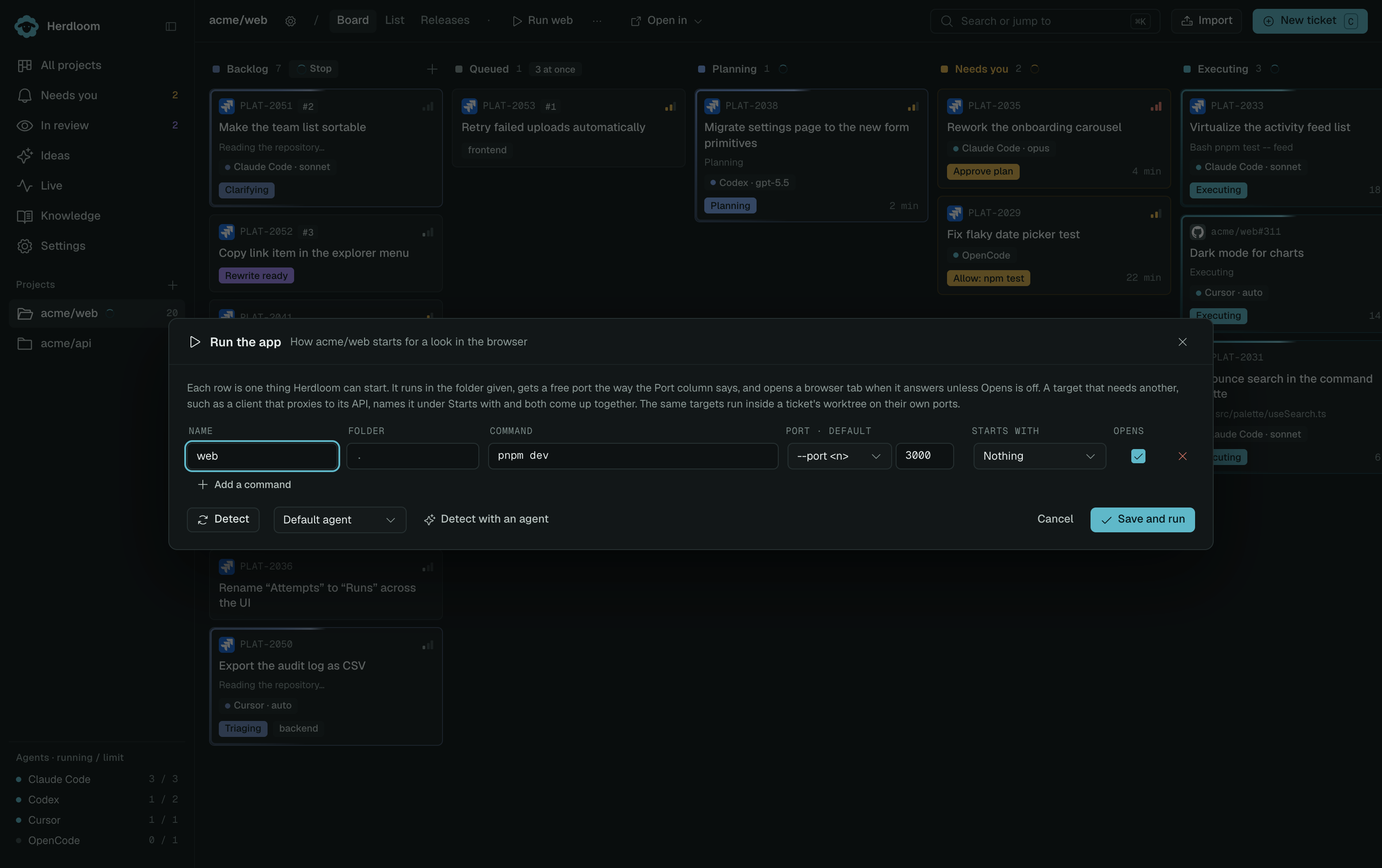
Each row is one thing that can be started. The Command is what runs, the Folder is where it runs, and Opens decides whether a browser tab is opened when the server answers. A backend with no page of its own has that switch off. A client that proxies to a backend names it under Starts with, so one press brings both up in the right order.
Detection wires that pairing itself where it can, by reading the client’s own configuration for the address it proxies to.
When the guesses fall short, Detect with an agent has a read-only pass read the repository, READMEs included, and propose the commands. What the agent said is shown in a panel of its own, separate from what Herdloom found. A repository that starts through a Makefile or a paragraph of prose usually needs this.
The list is saved on the project, and the Run the app card in project settings edits it later.
Each row says how its command takes a port and what the default is. Herdloom starts at the framework’s own default, so the main checkout keeps the port people expect. A server started for a ticket branch takes the next free one.
That is what makes a comparison possible. The main checkout on its usual address and a ticket’s branch beside it, both running, one tab each.
Running a ticket’s branch
Section titled “Running a ticket’s branch”The same Play button appears in the ticket drawer, and starts the same targets inside that ticket’s own checkout. If the checkout was parked after the run, Restore worktree to run it brings it back first.
A running server shows as a chip with its port, with Open, Output and Stop beside it. A ticket card on the board says which port its branch is running on. Output keeps the last couple of hundred lines, with secrets redacted the way every log is.
Stopping
Section titled “Stopping”Stop ends the server and anything it started, then anything still holding the port, and waits for the port to be free before it reports done. A port another process refuses to give up is named in the error.
A checkout is never removed while a server is running in it.
Read the diff for the other half of a review. Open in your editor hands the same folder to your own tools.